
Autophagy: A Longevity Evidence Check
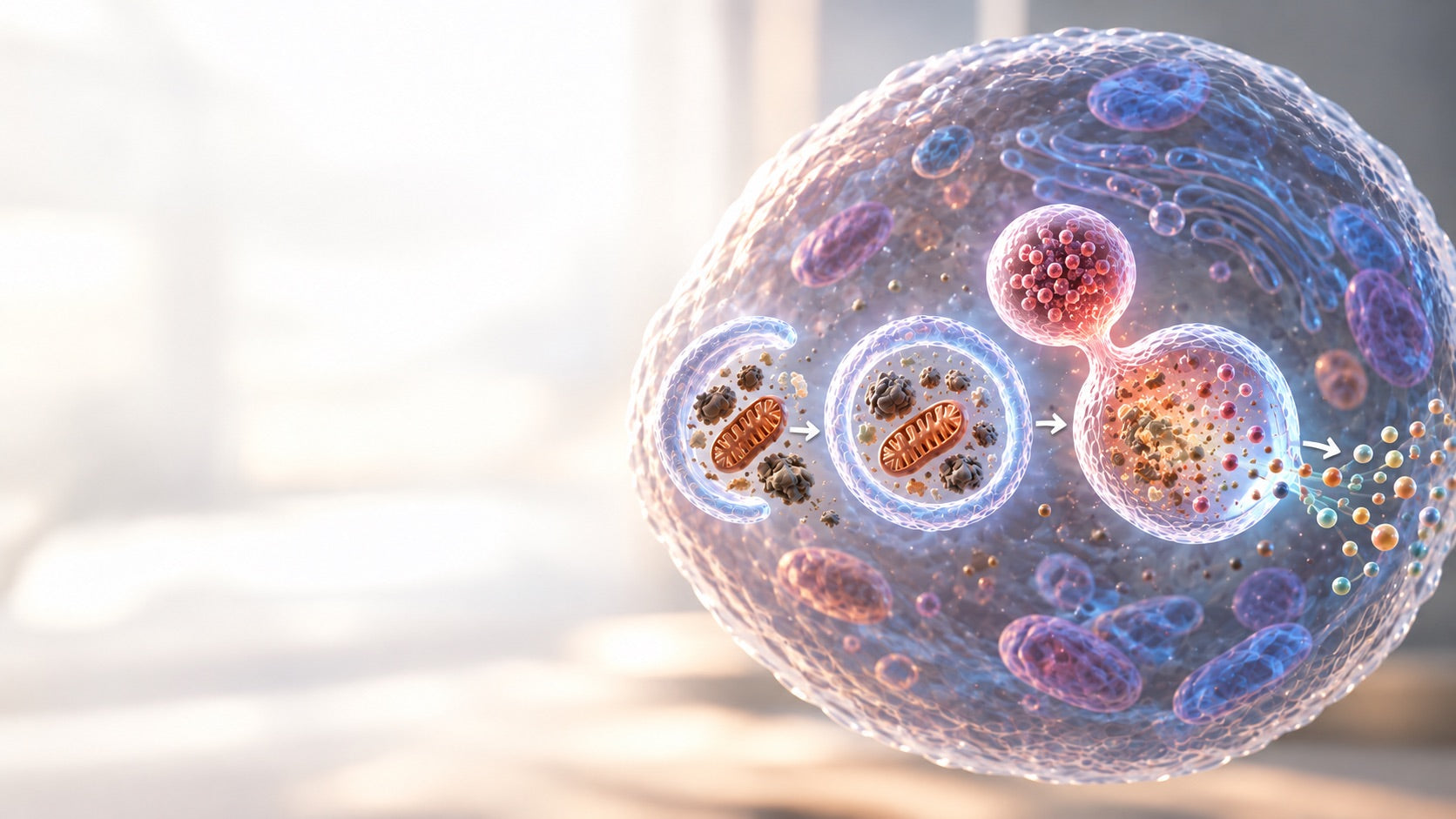
Fasting for cellular cleansing, spermidine to activate autophagy and rapamycin to slow aging? Research has produced fascinating results. However, much of the evidence comes from studies in mice, worms or cell cultures. What has actually been demonstrated in humans? A closer look at clinical studies reveals how large the gap can be between a biological mechanism and a meaningful health benefit.
Autophagy is one of the most widely discussed topics in Longevity research. In podcasts, scientific articles and supplement marketing, it is often described as the body's cellular recycling system. A process that removes damaged cellular components and might even help slow aging.
Particularly popular is the idea that we can deliberately activate this mechanism, for example through 16 hours of fasting or by taking certain supplements.
The scientific rationale sounds convincing. After all, basic research has produced remarkable findings.
But the fact that a biological mechanism is important does not mean that deliberately activating it will improve our health or extend our Healthspan.
This is where a closer look at human clinical studies becomes essential.
Autophagy: How does cellular recycling work?
Autophagy literally means "self-eating". It describes a natural process through which cells break down and recycle damaged or unnecessary components.
These include misfolded proteins and damaged organelles. They are transported to structures called lysosomes, where they are broken down and some of their components are reused.
Autophagy is therefore a fundamental part of cellular quality control. In 2016, Japanese cell biologist Yoshinori Ohsumi received the Nobel Prize in Physiology or Medicine for discovering important mechanisms of autophagy.
Importantly, autophagy does not need to be switched on by fasting. It occurs continuously and is regulated according to biological needs.
The interesting question is therefore not whether autophagy matters. It is whether we can deliberately influence it and thereby demonstrably improve how we age.
Why mouse studies attract so much attention
Preclinical research has indeed produced remarkable results.
In yeast, roundworms, fruit flies and mice, modifying certain signaling pathways can influence aging processes and sometimes extend lifespan.
One well-known example is mTOR, a signaling pathway involved in cell growth, protein synthesis and cellular recycling.
When mTOR is inhibited by rapamycin, numerous mouse studies have reported an extension of lifespan. Calorie restriction also affects lifespan in several animal species. Autophagy may contribute to some of these effects.
This makes the research interesting. But it does not establish a corresponding benefit in humans.
Rapamycin and calorie restriction influence numerous biological processes simultaneously. Even when experimental animals live longer, it remains unclear which mechanisms are responsible.
Longer lifespan in mice is not clinical evidence of a longer Healthspan in humans.
What human studies actually show about autophagy
For a long time, reliably measuring autophagy in living humans was itself a major challenge.
Many studies measured individual proteins or signaling pathways. These can provide clues about autophagy, but they do not necessarily demonstrate that more cellular material is actually being broken down.
There has recently been some progress.
A 2025 study by Bensalem and colleagues, published in The Journal of Physiology, investigated 121 adults with obesity. The researchers compared different dietary interventions, including continuous calorie restriction and intermittent fasting.
They measured what is known as autophagic flux. This describes the actual progression of the cellular breakdown process. Unlike measurements of individual proteins, it is intended to provide a better indication of whether cellular components are actually being degraded.
After six months, the fasting intervention showed a statistically significant difference compared with the control group.
However, three important limitations need to be considered.
First, autophagy was measured in specific blood cells. The findings cannot automatically be transferred to muscles, the brain, the liver or the entire body.
Second, the statistically significant between-group difference came from an exploratory analysis. Such analyses can identify interesting patterns, but they provide less conclusive evidence than analyses specified before a study begins.
Third, the change within the fasting group compared with its own baseline was not statistically significant.
The study therefore provides an interesting indication of possible changes in autophagy in certain human blood cells. It does not demonstrate a general increase in autophagy throughout the body or a corresponding health benefit.
Why small human studies do not yet provide certainty
Another pilot study, published in 2025 by Espinoza and colleagues, investigated 30 adults over eight days.
The researchers observed changes in several markers related to autophagy. However, the results were not consistently statistically significant.
Two aspects are particularly important when interpreting these findings.
With only 30 participants, the study was small. This can make genuine effects more difficult to detect statistically. At the same time, individual findings may be more strongly influenced by random variation.
The study was also funded by L-Nutra. This does not automatically make its findings unreliable. However, funding sources are relevant information when critically evaluating scientific research.
Both studies demonstrate that measuring autophagic processes in humans is becoming increasingly feasible.
They do not demonstrate that the interventions rejuvenate human cells or extend Healthspan.
A statistically non-significant result does not automatically prove that an intervention has no effect. It means that the study did not provide sufficiently convincing evidence for the difference being investigated.
Does autophagy really start after 16 hours of fasting?
One particularly persistent claim is that autophagy begins after a specific period of fasting.
Sometimes the threshold is said to be 12 hours, sometimes 16 or 24 hours. The longer the fast, the more intensive the supposed cellular cleansing.
There is currently no robust evidence from human studies supporting such universally applicable thresholds.
Autophagy is not a switch that suddenly turns on after 16 hours. Its regulation differs between tissues and depends on numerous biological factors.
This does not mean that intermittent fasting is ineffective.
A 2025 systematic review published in the British Medical Journal analyzed 99 randomized trials involving 6,582 adults.
Intermittent fasting reduced body weight, but was generally not substantially more effective than continuous calorie restriction. Only alternate-day fasting showed a small additional weight reduction averaging 1.29 kilograms.
For the autophagy debate, this distinction is essential.
Even if fasting produces health benefits, this does not establish that those benefits are caused by increased autophagy.
Spermidine and Urolithin A: What clinical studies show
Certain supplements are also marketed for their potential to activate cellular recycling processes.
One example is spermidine. Preclinical studies suggest that it may influence autophagy and extend lifespan in certain model organisms.
A randomized, placebo-controlled study conducted at Charité in Berlin investigated daily supplementation with 0.9 mg of spermidine over twelve months in older adults reporting subjective memory problems.
The result: There was no statistically significant benefit compared with placebo for the primary endpoint, memory performance.
This does not prove that spermidine is generally ineffective. The findings apply to the specific dose, population, study duration and outcome investigated.
However, a clinically relevant benefit for memory performance was not demonstrated under these conditions.
The evidence for Urolithin A requires similarly careful interpretation.
This compound is primarily investigated in connection with mitophagy, the selective breakdown of damaged mitochondria, which play a central role in cellular energy production.
A randomized human study involving 66 older adults found improvements in certain measures of muscle endurance and mitochondrial biomarkers.
However, neither of the two primary endpoints, the six-minute walking distance and maximum ATP production in hand muscles, showed a statistically significant benefit compared with placebo.
Here too, individual positive findings may be scientifically interesting. But they do not replace convincing evidence of a clinically meaningful overall benefit.
A plausible biological mechanism does not guarantee a measurable clinical benefit. And a change in a biomarker is not evidence of a longer Healthspan.
What is already better studied for your Longevity
Despite the fascination with cellular mechanisms, we should not overlook that other approaches to maintaining health have already been investigated much more extensively in humans.
Regular physical activity is one example. Higher cardiorespiratory fitness and adequate muscle strength are associated with lower disease and mortality risks in observational studies.
Moderate calorie restriction has also been investigated in longer randomized human trials.
The CALERIE study demonstrated improvements in several cardiometabolic risk factors over two years. Subsequent analyses also identified small changes in an epigenetic marker estimating the pace of biological aging.
Whether these changes actually extend human lifespan remains unproven.
The difference is not that we already understand every mechanism involved in exercise, nutrition or calorie restriction.
It is that certain health benefits have been investigated directly in humans and, in some cases, clinically demonstrated.
What this means for your Longevity decisions
Autophagy remains a fascinating field of research. There are good reasons to continue investigating this important biological mechanism.
However, the available evidence is insufficient to claim that deliberately activating autophagy through fasting or supplements has been shown to extend Healthspan in humans.
This does not mean that these interventions are necessarily ineffective. It means that the claimed benefits have not yet been adequately demonstrated.
When a product claims to activate autophagy, three questions are worth asking:
- Was the mechanism actually investigated in humans?
- Did the intervention change only a biomarker, or did it demonstrate a relevant health benefit?
- Has that benefit been confirmed in independent, sufficiently large clinical trials?
For your Longevity, what matters is not how fascinating a biological mechanism sounds. What matters is whether an intervention demonstrably improves your health.
Understanding this distinction helps separate promising research from premature claims.
Want to learn more?
- Bensalem et al. (2025). Intermittent time-restricted eating may increase autophagic flux in humans: an exploratory analysis. The Journal of Physiology. https://doi.org/10.1113/JP287938
- Espinoza et al. (2025). Effect of fasting-mimicking diet on markers of autophagy and metabolic health in human subjects. GeroScience. https://doi.org/10.1007/s11357-025-02035-4
- Schwarz et al. (2022). Effects of Spermidine Supplementation on Cognition and Biomarkers in Older Adults With Subjective Cognitive Decline. JAMA Network Open. https://doi.org/10.1001/jamanetworkopen.2022.13875
- Liu et al. (2022). Effect of Urolithin A Supplementation on Muscle Endurance and Mitochondrial Health in Older Adults. JAMA Network Open. https://doi.org/10.1001/jamanetworkopen.2021.44279
- Intermittent fasting strategies and their effects on body weight and other cardiometabolic risk factors. BMJ. 2025. https://doi.org/10.1136/bmj-2024-082007